Everything Is a Singleton
Twenty-two registrations, zero scoped, zero transient - a lifetime decision that buys a genuinely fast request path and enables exactly three bugs, all of them the same mistake.
Newest first, grouped by year. Search or filter by topic.
Twenty-two registrations, zero scoped, zero transient - a lifetime decision that buys a genuinely fast request path and enables exactly three bugs, all of them the same mistake.
services.BuildServiceProvider() inside ConfigureServices - what it actually costs, why it does not leak here, and how a zero-parameter extension method signature forced it.
The README and the sample both configure an auth claims alias map, the configuration class has no such property, and the binder's ignore-unknown-keys behaviour is what makes the omission silent.
Three components decide independently whether a route needs authentication, only one of them consults auth.enabled - and the combination that turns a public route into a 403.
A validated POST is parsed, re-serialised and parsed again on its way to a schema compiled fresh per request - and when it fails validation the caller gets HTTP 200.
Two mini-languages share one parser that runs both resolvers unconditionally and strips the first and last character from every token - and it is correct only by coincidence.
Two notions of module identity, a silent continue on a missing file - and a live bug the unreachable code was hiding.
Forty lines build every upstream path Ntrada can express, and thirty more build the downstream URL - where named segments substitute, one key appends, and one config flag runs backwards.
Ntrada's request pipeline is a gate and a dictionary lookup - and four extension hooks around it, one of which lost the thing it existed to see when a disposal bug was fixed.
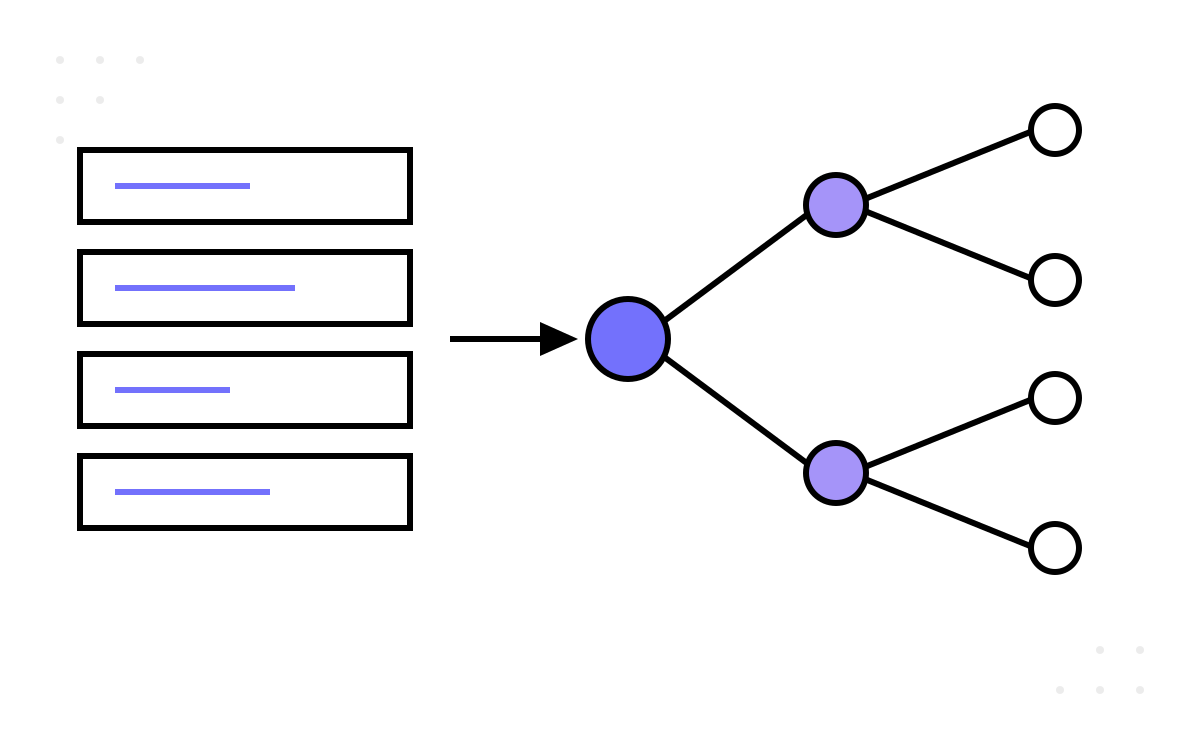
Ntrada writes no middleware - it compiles YAML into ASP.NET Core endpoints and lets the framework's matcher do the work. Then you try to declare a PATCH route.
Inflow's last commit landed on 23 July 2022 and nothing in the repository says so. The retrospective on eleven parts of reading a teaching repo as an artefact - what it gets right, what it costs, and what four passes over one estate add up to.
A 2018 API gateway promises that routing, auth, validation and messaging need no code at all - this series reads the source that makes the promise true, and the places where it is not.
Inflow is full of deliberate, defensible simplifications. One of them is explained in a code comment, and it is instantly legible as a teaching decision. The other seven are indistinguishable, on the evidence in the repository, from bugs.
Inflow throws at startup if a module's local copy of another module's event has changed shape. The rule the whole repository exists to demonstrate - that no module may reference another - is protected by nothing at all.
Inflow's .NET 6 upgrade touches 519 files. Run the diff with whitespace ignored and almost all of it is one Rider refactoring - and the three real changes, plus two design rewrites nobody announced, are hiding underneath it.
Inflow ships the same exercise twice, on two branches prepared eleven days apart from the same commit. They do not start from the same place, neither converges on master, and both carry a README describing components they have deleted.
One branch in Inflow carries five commits timestamped 11:56, 13:49, 14:11, 14:49 and 16:08 on a single Saturday. That is not a development history - it is a live teaching session committed as it happened, and it explains a defect on master.
Four articles of defects earn an audit. Inflow's README makes fifteen checkable claims and eleven of them hold - including the strongest one, checked edge by edge across all twenty project files. Here is the ledger, and why a short README is so hard to falsify.
Inflow's request collection contains a captioned request that grants full administrative permissions to an anonymous caller. The mechanism is four lines long, the documented happy path requires it, and the repository nowhere says it is on purpose - here is all of that, and the case for the defence.
GET /payments returns a 404 in Inflow's own root request file. The reason is not a typo - it is the Payments module exercising exactly the architectural freedom the README advertises, which makes this 404 the best evidence in the repository that the claim is true.
Getting money into a wallet in Inflow takes five HTTP requests and nine in-process reactions nobody documents. Reconstructing that path from source is the only way to get it - and every failure along it returns 204 No Content.
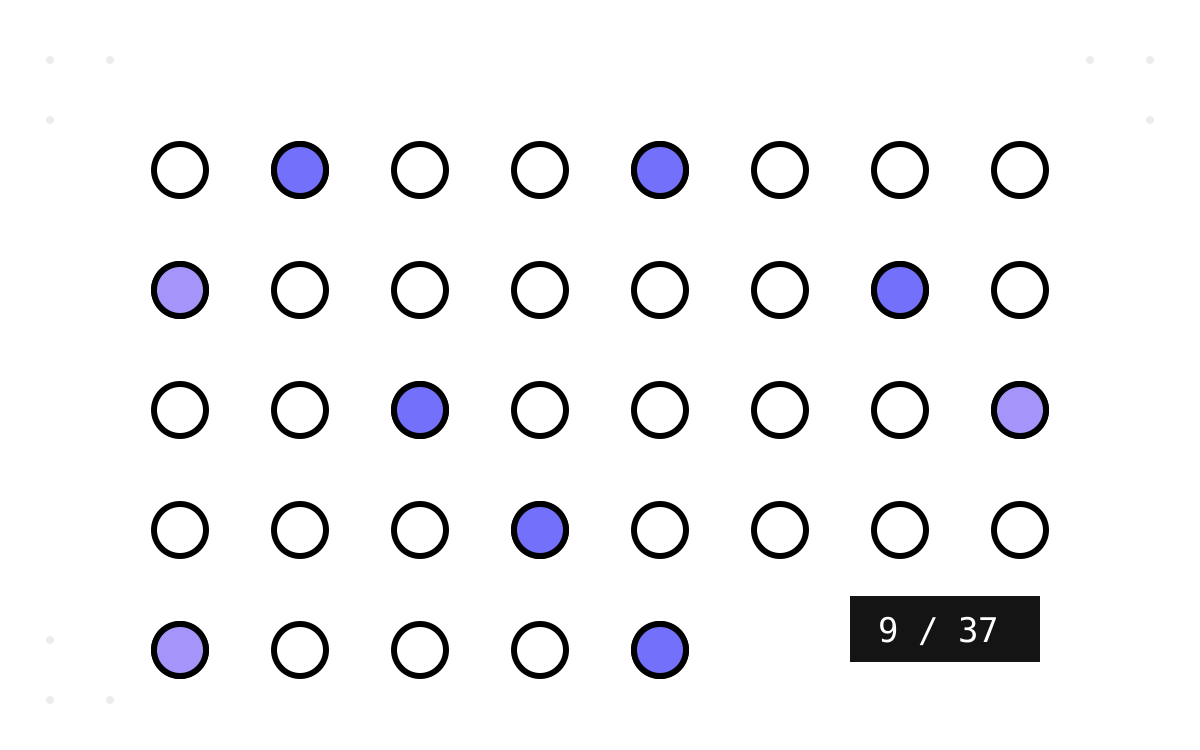
Inflow ships an executable request collection - five .rest files, thirty-seven requests. On a fresh clone nine of them return a 2xx, and eight of those nine are in one file. This series reads the repository itself as the artefact.
One sentence describes every failure convention in Inflow's shared framework - startup misconfiguration throws, runtime message failure is logged and dropped. The retrospective on fourteen parts of source-reading, including what to steal, what to avoid, and where this design should not go.
Inflow reads every configuration section by building and disposing an entire service provider - twenty-two of them during startup. Two of those calls do not read anything; they mutate a registry, and they only work because of how three singletons were registered.
Inflow's inbox writes a row only after the handler succeeds, which makes its own duplicate-check predicate dead code and its name wrong. It is a good Idempotent Receiver with a one-hour memory, a decorator that resolves from the wrong provider, and an orphaned brace pair.