Skip to content
kc@kumarChandrachooda.com:~$ cd /blog/archive && read --section="top" 0%
Archive

Every article

Newest first, grouped by year. Search or filter by topic.

  • 556 articles
  • 50 matching
Architecture 27 Jan 2026

Boot Loudly, Fail Quietly

One sentence describes every failure convention in Inflow's shared framework - startup misconfiguration throws, runtime message failure is logged and dropped. The retrospective on fourteen parts of source-reading, including what to steal, what to avoid, and where this design should not go.
Architecture 26 Jan 2026

The Container You Build to Read a Setting

Inflow reads every configuration section by building and disposing an entire service provider - twenty-two of them during startup. Two of those calls do not read anything; they mutate a registry, and they only work because of how three singletons were registered.

Architecture 25 Jan 2026

An Inbox That Is Really a Ledger

Inflow's inbox writes a row only after the handler succeeds, which makes its own duplicate-check predicate dead code and its name wrong. It is a good Idempotent Receiver with a one-hour memory, a decorator that resolves from the wrong provider, and an orphaned brace pair.

Architecture 25 Jan 2026

Two Flags, Four Systems, One That Stalls

Two booleans govern Inflow's messaging spine. Taking their product gives four behaviours - one shipped and working, two working differently, and one that throws a NullReferenceException every second forever because the component that would prevent it only exists in another cell.

Architecture 24 Jan 2026

The Outbox That Commits Somewhere Else

Inflow ships a complete transactional outbox - table, poller, cleanup jobs, type registry - and one CreateScope() call means the outbox row commits on a different DbContext from the state change it is supposed to be atomic with.

Architecture 23 Jan 2026

Nine Lines Stop a Stack Overflow

Inflow registers every handler by assembly scan and then wraps them in decorators. Those two techniques are incompatible unless something tells the scanner to skip the decorators - and in this codebase that something is a marker attribute with no tests and no comment explaining what it prevents.

Architecture 23 Jan 2026

One Assignment Freezes Every Trace

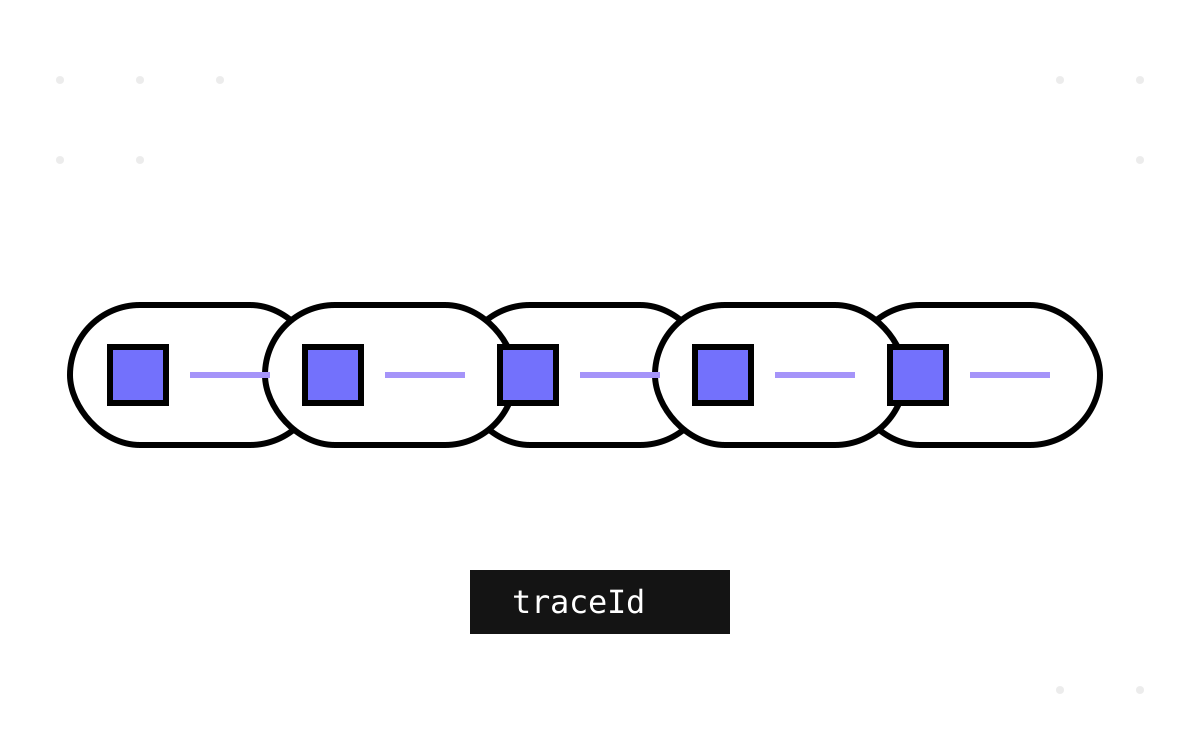
Inflow carries request identity across its async message boundary in a static AsyncLocal. The line that populates it uses null-coalescing assignment inside a long-lived loop, so every message after the first runs under the first one's correlation id, trace id and user.

Architecture 22 Jan 2026

The Bus That Never Leaves the Process

Inflow's message broker is eighty-eight lines with a three-way branch, backed by an unbounded channel and a single background reader. Reading it shows where the delivery guarantee actually is - and that on shutdown, whatever is still queued is discarded without a log line.

Architecture 21 Jan 2026

Four of Eighteen Copies Are Checked

Inflow's boot-time contract verifier is excellent and almost unused. A census of every consumer-side type copy in the estate shows four protected and fourteen not - and the two failure modes are a startup crash and a silently null property.

Architecture 21 Jan 2026

The Round Trip That Copies Every Message

Inflow isolates modules by serialising every message to JSON bytes and deserialising it into the receiver's own type - once per receiver. It is the Message Translator done well, and the byte array in the signature tells you exactly which transport it was built for.

Architecture 20 Jan 2026

Local Contracts, Verified at Boot

Inflow lets each module own a private copy of every event it consumes, then type-checks those copies against the producer at application start. It is consumer-driven contract testing with no broker, no schema registry and about 280 lines - and the check is weaker than the ceremony suggests.

Architecture 19 Jan 2026

A Namespace Segment Is a Routing Key

One method in Inflow returns the third segment of a type's namespace, lower-cased. Four subsystems route on that string, and nothing anywhere validates it - a namespace rename is a silent behavioural change across the estate.

Architecture 19 Jan 2026

Your Type Name Is the Wire Contract

Inflow has no subscribe call and no topic string. A module receives an event by declaring a class with the same simple name, and a single attribute decides whether the delivery is allowed - with a cache that changes the decision, not just its speed.

Architecture 18 Jan 2026

The Bootstrapper Is Seventy-Six Lines

Inflow's host knows nothing about its five modules - it finds them by scanning DLL filenames and reflecting for an interface. Reading the loader shows why the whole estate is that small, and where a missing settings file silently deletes a module.

Architecture 17 Jan 2026

Five Modules That Cannot See Each Other

Every modular monolith claims its modules are decoupled. Inflow proves it the only way that counts - by having no project reference between any two of them - and then has to build a whole mini-framework to make that survivable. Part 1 of a source-read through the shared layer.

Architecture 06 Jan 2026

Ten Hours and No Way Back

The rewrite multiplied the JWT lifetime by ten and deleted the only way to revoke a token early - one change in a JSON file, the other an absent folder, and neither visible in any diff of the domain.

Architecture 06 Jan 2026

The Rewrite Kept Every Bug

Four non-trivial defects appear at near-identical line numbers in both builds of the same product - a ground-up rewrite by the same authors relocated them rather than finding any.

Architecture 05 Jan 2026

In-Process Is Not Synchronous

Trill's monolith routes every cross-module event through an unbounded channel drained by one background service - so its flagship end-to-end test has to sleep for two seconds to observe the architecture working.

Architecture 04 Jan 2026

Eighteen Containers Become Two

Running Trill as microservices takes eighteen containers and twenty-two published ports; running the same product as a monolith takes mongo, redis and dotnet run - and only the monolith still starts from a clean clone.

Architecture 04 Jan 2026

Minimal APIs, Written by Hand

Trill's monolith implements typed Get, Post, Put and Delete extensions over IEndpointRouteBuilder on .NET 5 - the framework .NET shipped eighteen months later, complete with query binding by string replacement.

Architecture 03 Jan 2026

Every In-Process Call Pays for MessagePack

Two lines in Trill's module client serialise and immediately deserialise every cross-module message, buying a future network hop at the cost of a round trip that never leaves the heap - and there is a benchmark project defending the choice.

Architecture 02 Jan 2026

Guid.Empty Is a Mode Flag

Trill's monolith puts the envelope fields on the message itself, then uses one sentinel value to mean this-is-a-synchronous-call in three unrelated subsystems that never mention each other.

Architecture 02 Jan 2026

The Contract Checker They Built After the Drift

The Trill monolith ships a startup-time validator that compares independently declared copies of the same message and crashes the app on a mismatch - the most original idea in either build, adopted by four declarations out of twenty-two.

Architecture 01 Jan 2026

AddX, UseX, and Two Deliberate Violations

Trill's hand-rolled framework follows the ASP.NET Core registration convention with unusual discipline, then breaks it twice on purpose - and the exceptions turn out to be more instructive than the rule.

Architecture 31 Dec 2025

A Framework Instead of Twenty-Four Packages

Trill's saga microservice references twenty-four third-party packages; the same saga as a module references one - because the monolith deleted Convey and rewrote 4,600 lines of it by hand.