Five Metrics, Not Four
DORA as it actually stands - five metrics since the 2024 report, benchmarks dated to their vintage, the 2025 archetypes, and the comparison warning printed on the tin.
Newest first, grouped by year. Search or filter by topic.
DORA as it actually stands - five metrics since the 2024 report, benchmarks dated to their vintage, the 2025 archetypes, and the comparison warning printed on the tin.
A product whose entire interface is a YAML document, shipped in an image that document cannot enter - plus the resilience inventory of a gateway with retries and nothing else.
Running Trill as microservices takes eighteen containers and twenty-two published ports; running the same product as a monolith takes mongo, redis and dotnet run - and only the monolith still starts from a clean clone.
The series retrospective - what fourteen parts of reading Pacco as a system of systems actually taught, the absences the estate confesses when you list them together, how the successor evolved past DShop and where it stopped, and what the MIT licence makes of all of it.
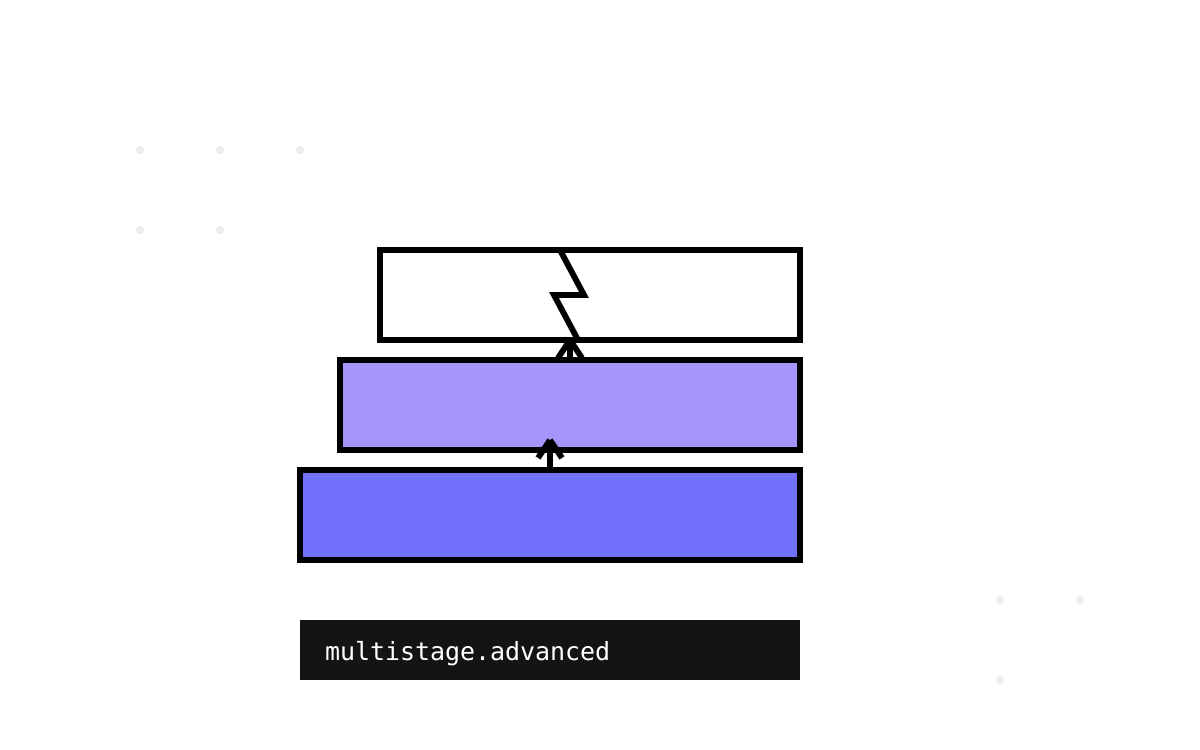
DShop.Api ships three Dockerfiles - plain, multistage, and multistage.advanced - as a teaching ladder. The top rung is broken, and all three share an ENTRYPOINT that quietly defeats graceful shutdown.
The honest retrospective that closes the series - how template scaffolding metastasizes mistakes, why version pinning without governance curates a museum, what secrets in locals really cost, and the upgrade list I would run on this estate today. Part 12 of the Terraform on Azure series.
Three manually-run pipelines, one JSON config bag and a TDE certificate wrinkle - how live SQL Server databases moved into Azure SQL Managed Instance with LRS, and why all the project risk compresses into the sixty seconds around cutover. Part 11 of the Terraform on Azure series.
Azure Blueprints driven from Terraform with forty templated parameters, platform-level delete locks, twelve-hour timeouts and PowerShell bookends on both sides of the apply - how the estate's most dangerous resource got its most governed deployment. Part 10 of the Terraform on Azure series.
local-exec key minting, external data sources wrapping PowerShell, and a post-apply ARM PATCH - the imperative seams that held a declarative Azure estate together, and the idempotency, portability and security bills they ran up. Part 9 of the Terraform on Azure series.
Each Logic App in this Azure estate was split across four sibling stacks - runtime, workflows, APIM registration and service discovery - a clean lifecycle separation that quadrupled the folder, pipeline and state count per integration. Part 8 of the Terraform on Azure series.
With no terraform_remote_state anywhere in 230 stacks, every cross-stack reference in this Azure estate was a literal name string - a taxonomy you could read from ls, a coupling with zero runtime dependencies, and a silent-drift hazard on every rename. Part 7 of the Terraform on Azure series.
Nine thin custom Terraform modules carried the entire platform-integration story of an Azure estate. This part dissects the APIM-publication half - key minting through local-exec, SAS-splitting through PowerShell, twin modules one hyphen apart, and a typo frozen into dozens of source strings. Part 5 of the Terraform on Azure series.
Two generations of Terraform pipeline in one Azure estate - manual parameterized plan-and-apply consoles beside gated plan-artifact promotion - and why applying the exact plan you approved is the rung that matters. Part 4 of the Terraform on Azure series.
Empty backend blocks, per-environment storage accounts and a state file for every stack-environment pair - how one Azure estate partitioned a thousand Terraform states for blast radius, and what that sprawl cost. Part 3 of the Terraform on Azure series.
How workspace-keyed lookup maps and a single platform-facts JSON file let hundreds of Terraform stacks run identically in dev, staging and prod - and when a forgiving lookup default is the wrong kind of kindness. Part 2 of the Terraform on Azure series.
Four pipelines run dotnet test against projects with no tests and pass every time, the shared model ships as committed .nupkg files in a folder, one executable has no pipeline at all, and a DLL with no source hides an algorithm pasted inline elsewhere.