What Convey Got Right — and What Modern .NET Ate
Closing the series with an honest audit of the chassis - which of Convey's ideas still earn their keep in 2026, which ones the platform absorbed, and what I would build differently today.
Newest first, grouped by year. Search or filter by topic.
Closing the series with an honest audit of the chassis - which of Convey's ideas still earn their keep in 2026, which ones the platform absorbed, and what I would build differently today.
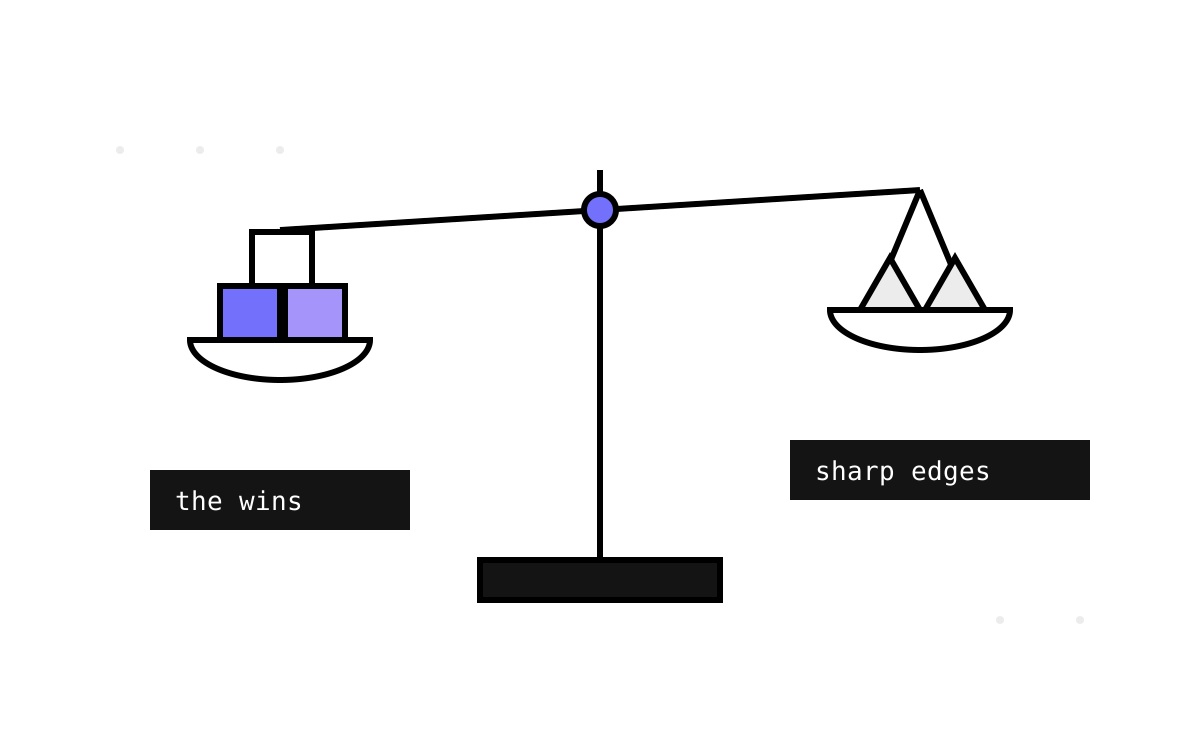
After sixteen parts inside the source, the honest retrospective - what the library gets right, the sharp edges that will cut you (singletons, statics, magic), and the projects where I would leave it on the shelf. Part 17, the conclusion of FastEndpoints in Depth.
The retrospective: after ten parts inside DevMentors' real-time feeds sample, the honest scorecard - five decisions worth stealing for real systems, the sharp edges catalogued in one place, and the concrete backlog that separates this teaching codebase from a production deployment. Part 11 closes the FeedR deep dive.
The honest retrospective on two weighted competency frameworks - the blank templates at their centre, the qualities no weight can hold, the situations where a weighted model is the wrong tool, and what I would build differently.
The honest retrospective that closes the series - how template scaffolding metastasizes mistakes, why version pinning without governance curates a museum, what secrets in locals really cost, and the upgrade list I would run on this estate today. Part 12 of the Terraform on Azure series.
From an inverted foundation to the version I'd deploy, KC Star evolved through ten explicit releases in the open. The retrospective on all of it - what versioning a schema publicly taught me about drift, variants, bugs as motivations, and simplicity as the real destination.
The series retrospective - what a thirty-file library taught me that a full-featured one couldn't, Pactify's honest limit list versus PactNet, the broker maturity ladder, and the org-shaped question hiding under the tooling.
The series retrospective - what was borrowed and from whom, what my extensions add and what they cost, the gap between the workflow as described and the runs I can actually evidence, and what I would do differently.
PREVC's fifth phase is the one most cycles skip - a structured retrospective that turns observations into harness changes, and release documentation that writes the next cycle's requirements before it starts.
Nine parts of architecture posts lie by omission unless the tenth is the ledger. What earned its keep — isolation as data, MaxTenants = 1, the schema-keyed model cache — and the honest list of shortcuts: plaintext connection strings, cache windows, reflection, and a fan-out loop that still says TODO.
The honest retrospective this series owes its readers - the thesis I believe but cannot cite, the threshold that is really one team's habit, the discipline with no how-to, the figures that will age, and the work you should not hand to an agent at all.
The series retrospective - what fourteen parts of reading Pacco as a system of systems actually taught, the absences the estate confesses when you list them together, how the successor evolved past DShop and where it stopped, and what the MIT licence makes of all of it.
The series retrospective - Pacco's domain teaches real rules (state machines, priority expropriation, loyalty ladders, compensations) on top of cardboard data (bare-decimal prices, one vehicle per order, size-cube parcels, no payment, and a capacity check that ships in two halves nobody ever connects). What to steal, what to distrust, and what fourteen parts of source-reading add up to.
The retrospective that closes three series on DShop - the whole map drawn once, the services wired into nothing, the skew across seventeen repos, and what reading someone else's estate end to end actually teaches.
A retrospective on DShop.Common - the frozen shared-contracts tombstone, a release candidate pinned forever, and a concordance of what Convey kept, renamed, and fixed.
A retrospective on nine DShop services - the order aggregate and checkout saga that genuinely work, sitting next to the discount that only prints, the emails that never send, and a currency guard that guards nothing. Part 15 of Nine Services and a Message Bus.
The honest ledger for the whole estate - what coordinating through tables actually cost, what genuinely earned its keep, and what I would reach for now instead of using the database as a message bus.
The honest retrospective - copy-paste as a pattern, zero tests, PII in telemetry and what employee-monitoring data demands, destructive error handling, and the handful of decisions that genuinely earned their keep.