Skip to content
kc@kumarChandrachooda.com:~$ cd /blog/category/microservices && read --section="01 microservices" 0%
Topic

Microservices

203 articles filed under this topic.

Series in Microservices
Series · 8 parts

Contract Testing with Pactify

Unit tests mock what you assume, end-to-end tests tell you too late - consumer-driven contract testing closes the gap, and a small open-source .NET library called Pactify is the clearest way I know to learn how it works. Part 1 of a series.
Series · 8 parts

Convey — The Missing Chapters

The 22-part Convey series read the packages; it never once walked the sample system that ships with them. Opening the missing chapters with the trip an order takes through Orders, Pricing and Deliveries — and what the samples quietly teach that no package README does.

Series · 16 parts

GroupFlights — Strategy Before Code

Most repositories ship code and a README - this one ships four ADRs with a named approver, a context map, a domain message flow and a methodology poster. Part 1 of a series that reads the strategic half of DevMentors' GroupFlights.

Series · 22 parts

Microservices with Convey

Every team's fifth microservice ships with the same four hundred lines of bootstrap code as the first four. Opening a deep-dive series on Convey, the open-source .NET toolkit that turned that boilerplate into thirty composable packages.

Series · 15 parts

Nine Services and a Message Bus

DShop is one e-commerce shop stamped out as nine microservices over RabbitMQ - this series reads the real source to see how the topology holds together and where it drifts. Part 1 of Nine Services and a Message Bus.

Series · 12 parts

One Module Leaves the Process

Every modular monolith promises you can extract a module later. Inflow has a branch where someone actually did it - one module lifted into its own process behind a gateway and a real broker. This series reads that branch line by line.

Series · 16 parts

One Shop, Every Shape

DevMentors built the same e-commerce shop twice - once as a monolith, once as nine services - with two gateways and two frontends. This series reads the whole estate as one artefact.

Series · 11 parts

Real-Time Feeds with FeedR

A guided tour of FeedR, DevMentors' open-source .NET microservices sample for real-time data feeds - six services, Redis pub/sub, Apache Pulsar and a gRPC stream, and the two-tier eventing model that makes it worth reading. Part 1 of a source-level deep dive.

Series · 9 parts

Sagas with Chronicle

Split one database into five services and the transaction you deleted does not disappear - it goes feral. On sagas, compensation, process managers, and Chronicle, the small open-source .NET library this series reads line by line.

Series · 13 parts

The Convey Consumer Tax

Convey sells a microservice in thirty lines, and Pacco builds ten of them - this series reads the whole estate to price what the framework compresses and what every consumer pays for by hand. Part 1 of The Convey Consumer Tax.

Series · 15 parts

The Order That Choreographs Itself

Nobody in Pacco approves an order - a vehicle reservation does. A tour of DevMentors' parcel-delivery estate, the domain it models, and the fifteen-part series it earns.

Series · 13 parts

Trill Two Ways

DevMentors shipped Trill as nine microservice repos, then rebuilt the identical product as a modular monolith three months later - giving us a controlled experiment in architecture that almost never exists in public.

Series · 15 parts

Trill — Reading the Services

Trill's Stories service is four projects with a dependency-free domain at the bottom. Its Users service is two projects with everything in one assembly - same author, same week, same estate, opposite answers to what a layer is.

Series · 15 parts

Trill — The Microservices Spine

The DevMentors Trill estate is a nine-service microservices sample spread over eleven sibling repositories with no README, no clone script and no bootstrap tooling - and the only artefact that names the whole system is a Visual Studio solution file.

Series · 15 parts

Two Gateways and a Nervous System

Thirteen repositories, one umbrella that runs twelve of them, two interchangeable API gateways and a service that watches everything - the Pacco estate read as a system of systems, and the fifteen-part series it earns.

Everything in Microservices View
Architecture 04 Feb 2026

The Seam Held, the Envelope Did Not

Eleven parts of reading one commit. Inflow's dependency-inversion boundary survived a real transport swap intact - and everything ambient that used to travel with a message did not. The retrospective, the ledger, and what I would take from it.

Architecture 03 Feb 2026

Four Lines From a Switch

Inflow's transport seam is one method wide and genuinely transport-agnostic, but it has exactly one implementation and no default. A four-line Null Object and one if statement would have turned a fork in the road into a configuration flag.

Architecture 03 Feb 2026

Nobody Moved the Data

The extracted Customers service ships one EF migration that creates three empty tables in a brand-new database. Nothing dual-writes, nothing backfills, nothing reconciles - and the only path that repopulates the service is events that have not happened yet.

Architecture 02 Feb 2026

Contract Checking Left When the Network Arrived

Inflow's monolith failed startup when two modules disagreed about the shape of a shared event. The microservices branch deletes that check from exactly the boundary that became remote - and it turns out the deletion was not optional.

Architecture 01 Feb 2026

Extraction by Copy and Disable

Inflow did not delete the module it extracted. It copied sixty-odd files into a new service, flipped one boolean, and left both copies in the solution - a decision that is better than it first looks and costs more than it first looks.

Architecture 01 Feb 2026

The Envelope That Did Not Cross

Inflow publishes a message id onto the wire, RabbitMQ delivers it, and the subscriber never reads it. The response was a guard that skips deduplication rather than one that reads the id - and the correlation id that does cross is a fresh random Guid.

Architecture 31 Jan 2026

Your Routing Key Is a Class Name

On Inflow's microservices branch the wire address of every event is derived from the CLR type name, computed independently on both sides of the network. Two records in two assemblies match only because someone spelled them the same way.

Architecture 30 Jan 2026

Eight Queue Names Hold the Fan-Out Together

Inflow's queue template would have given three modules one shared queue and turned publish-subscribe into competing consumers. Eight hand-written string literals in three projects are what prevent it - and forgetting a ninth would not be an error, just silence.

Architecture 30 Jan 2026

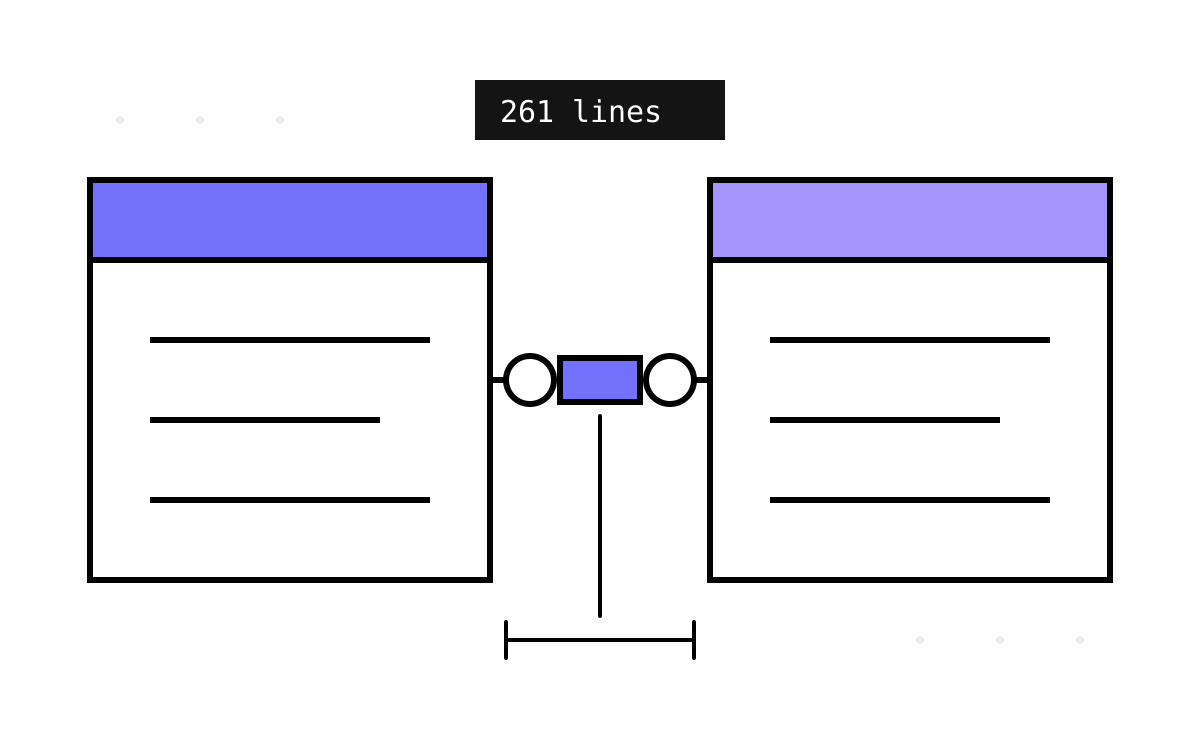
Two Hundred and Sixty-One Lines of Transport

The whole RabbitMQ adapter that makes Inflow's monolith talk to an extracted service is five files in one folder. Reading them shows how small a real transport swap can be - and where the fan-out quietly narrowed from every handler to exactly one.

Architecture 29 Jan 2026

The Interface That Did Not Move

Inflow's IMessageBroker is byte-identical on the monolith branch and the microservices branch, and not one handler, saga or controller changed to accommodate a real broker. That is a genuine result - and the reason it worked is also the reason for everything that goes wrong later.

Architecture 28 Jan 2026

A Hundred and Eight Files, Not a Hundred and Sixty-One

Ask git what an extraction cost and it will confidently give you the wrong number. Inflow's microservices branch diffs at 161 files against master - the honest figure is 108, and the fifty-three-file gap is a lesson in how migration retrospectives get fabricated.

Architecture 28 Jan 2026

The Branch Where the Monolith Splits

Every modular monolith promises you can extract a module later. Inflow has a branch where someone actually did it - one module lifted into its own process behind a gateway and a real broker. This series reads that branch line by line.

Architecture 06 Jan 2026

Ten Hours and No Way Back

The rewrite multiplied the JWT lifetime by ten and deleted the only way to revoke a token early - one change in a JSON file, the other an absent folder, and neither visible in any diff of the domain.

Architecture 06 Jan 2026

The Rewrite Kept Every Bug

Four non-trivial defects appear at near-identical line numbers in both builds of the same product - a ground-up rewrite by the same authors relocated them rather than finding any.

Architecture 05 Jan 2026

In-Process Is Not Synchronous

Trill's monolith routes every cross-module event through an unbounded channel drained by one background service - so its flagship end-to-end test has to sleep for two seconds to observe the architecture working.

Architecture 04 Jan 2026

Eighteen Containers Become Two

Running Trill as microservices takes eighteen containers and twenty-two published ports; running the same product as a monolith takes mongo, redis and dotnet run - and only the monolith still starts from a clean clone.

Architecture 04 Jan 2026

Minimal APIs, Written by Hand

Trill's monolith implements typed Get, Post, Put and Delete extensions over IEndpointRouteBuilder on .NET 5 - the framework .NET shipped eighteen months later, complete with query binding by string replacement.

Architecture 03 Jan 2026

Every In-Process Call Pays for MessagePack

Two lines in Trill's module client serialise and immediately deserialise every cross-module message, buying a future network hop at the cost of a round trip that never leaves the heap - and there is a benchmark project defending the choice.

Architecture 02 Jan 2026

Guid.Empty Is a Mode Flag

Trill's monolith puts the envelope fields on the message itself, then uses one sentinel value to mean this-is-a-synchronous-call in three unrelated subsystems that never mention each other.

Architecture 02 Jan 2026

The Contract Checker They Built After the Drift

The Trill monolith ships a startup-time validator that compares independently declared copies of the same message and crashes the app on a mismatch - the most original idea in either build, adopted by four declarations out of twenty-two.

Architecture 01 Jan 2026

AddX, UseX, and Two Deliberate Violations

Trill's hand-rolled framework follows the ASP.NET Core registration convention with unusual discipline, then breaks it twice on purpose - and the exceptions turn out to be more instructive than the rule.

Architecture 31 Dec 2025

A Framework Instead of Twenty-Four Packages

Trill's saga microservice references twenty-four third-party packages; the same saga as a module references one - because the monolith deleted Convey and rewrote 4,600 lines of it by hand.

Architecture 31 Dec 2025

One Database, Eleven String Literals

Four physical Mongo databases collapse into one when Trill is rebuilt as a monolith - and the only thing keeping the modules apart afterwards is a private const string copied into eleven files.

Architecture 30 Dec 2025

Boundaries the Compiler Enforces

Trill's monolith makes every module type internal and gives each one an explicit friend list, so a cross-module reach is not a code-review conversation - it is a build error.

Architecture 29 Dec 2025

The Same App, Built Twice

DevMentors shipped Trill as nine microservice repos, then rebuilt the identical product as a modular monolith three months later - giving us a controlled experiment in architecture that almost never exists in public.