An Event Bus in Seven Files
ModularMonolith builds its message broker from System.Threading.Channels and one BackgroundService - a textbook Message Channel and Event-Driven Consumer in miniature, with every missing enterprise-integration pattern visible by its absence.
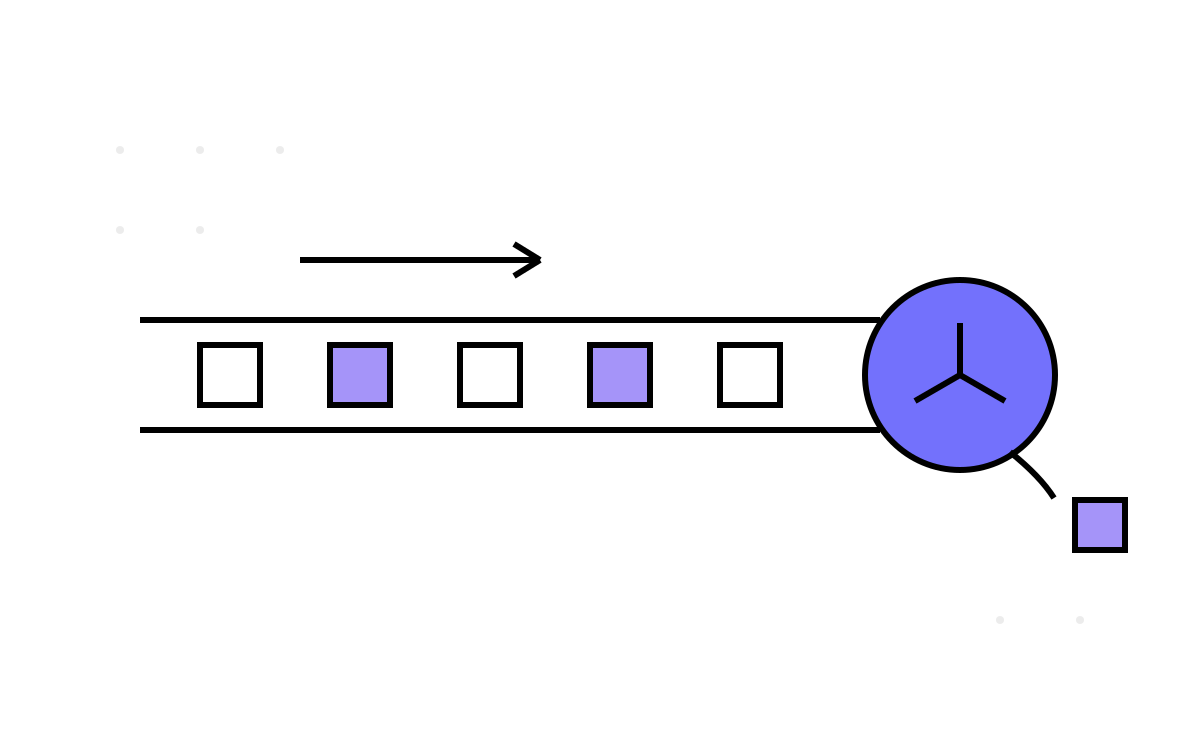
Message brokers feel like infrastructure you buy, not code you read. RabbitMQ, Azure Service Bus, Kafka — each hides the essential moves behind a connection string. The DevMentors ModularMonolith estate does something more instructive: it builds a working in-process event bus out of System.Threading.Channels in seven files small enough to read in one sitting, and in doing so gives every enterprise-integration pattern a face. Part 4 covered how this machinery boots; this part reads the mechanism itself.
The seven files live in Shared.Infrastructure/Messaging/: MessageChannel, IMessageChannel, AsynchronousDispatcher, IAsynchronousDispatcher, AsynchronousDispatcherJob, InMemoryMessageBroker, MessagingOptions — plus an Extensions.cs that registers them. All of it arrived in one commit, 60840b2, the estate's last.
The channel
The heart is barely a class:
internal sealed class MessageChannel : IMessageChannel
{
    private readonly Channel<IMessage> _messages = Channel.CreateUnbounded<IMessage>();

    public ChannelReader<IMessage> Reader => _messages.Reader;
    public ChannelWriter<IMessage> Writer => _messages.Writer;
}
Registered as a singleton, this is a literal EIP Message Channel: one shared conduit that producers write to and a consumer reads from, decoupling the two in time. Two design decisions hide in its two meaningful lines. It is untyped — a single channel of IMessage, not a channel per message type — so in Hohpe and Woolf's vocabulary it is a plain channel rather than a Datatype Channel; routing by type happens downstream. And it is unbounded: CreateUnbounded means writers never wait, which also means there is no backpressure anywhere in the system. A publisher that outruns the consumer grows the queue without limit; memory is the only regulator. Channel.CreateBounded<IMessage>(capacity) with a wait-on-full policy is one line away, and choosing it would force the interesting question — block the HTTP request or shed events? — that unbounded lets you defer indefinitely.
The interface exposes the raw ChannelReader/ChannelWriter rather than wrapping them. That is unusually honest plumbing: no abstraction tax, at the cost of any consumer being able to complete the writer or steal reads. In a sample, transparency wins.
The producer side
AsynchronousDispatcher is enqueue-and-return:
public async Task PublishAsync<TMessage>(TMessage message) where TMessage : class, IMessage
    => await _messageChannel.Writer.WriteAsync(message);
On an unbounded channel WriteAsync completes synchronously in practice, so publishing costs the caller almost nothing — fire-and-forget with the forgetting made structural. The HTTP request that publishes ConferenceCreated resumes immediately; whatever happens next is the consumer's problem, in every sense that part 8 will make precise.
The pump
The consumer is a stock BackgroundService, and it is the file to read slowly:
protected override async Task ExecuteAsync(CancellationToken stoppingToken)
{
    _logger.LogInformation("Running the async dispatcher job.");

    await foreach (var message in _messageChannel.Reader.ReadAllAsync(stoppingToken))
    {
        try
        {
            await _moduleClient.PublishAsync(message);
        }
        catch (Exception ex)
        {
            _logger.LogError(ex, ex.Message);
        }
    }

    _logger.LogInformation("Finished running the async dispatcher job.");
}
await foreachoverReadAllAsyncis the idiomatic channel consumer in 2021 C# and still today — no polling, no manualWaitToReadAsyncloop; the iterator suspends until a message arrives.- One consumer, sequential dispatch. There is exactly one pump, and it awaits each
PublishAsyncbefore reading the next message. That is Fowler's Singular Update Queue: all cross-module traffic serialises through a single point, which incidentally buys global event ordering — a property distributed systems pay dearly for, obtained here as a side effect of being one process. - The catch logs and drops. A message whose handler throws is written to the log at Error level and never seen again. No retry, no dead-letter channel, no poison-message counter. This is at-most-once delivery, chosen implicitly by the shape of a try/catch.
- The last line never runs. When the host stops,
ReadAllAsynchonoursstoppingTokenby throwingOperationCanceledException, which exitsExecuteAsyncpast the final log statement. “Finished running the async dispatcher job.” is unreachable in the normal shutdown path — a two-line tell that this code was never watched during a graceful stop. Harmless, and exactly the kind of detail an estate with tests or an ops runbook would have caught.
In EIP terms the pump is an Event-Driven Consumer feeding the publish-subscribe distribution that the module registry performs (part 6 follows a message through it).
The bus as a checklist of absences
Line the estate up against the Message Construction and reliability columns of the EIP catalogue and the reading gets sharper, because IMessage — the currency every file above trades in — is this:
// Marker
public interface IMessage
{
}
No message id, no correlation id, no timestamp, no version. Each absent field is an absent pattern, and each becomes concrete work the day any module needs it:
| Missing piece | EIP name | What its absence costs here |
|---|---|---|
| Message id | Idempotent Receiver's prerequisite | redelivery can never be deduplicated (moot today only because nothing retries) |
| Correlation id | Correlation Identifier | no way to trace an event back to the request that caused it |
| Retry with backoff | — | one transient handler failure permanently loses the event |
| Dead-letter channel | Dead Letter Channel | failed messages leave no queue to inspect or replay |
| Persistence | Guaranteed Delivery | channel contents die with the process |
| Version field | Format Indicator | contract drift is invisible — the exact wound part 7 shows bleeding |
That table is not a demolition; it is the syllabus. The seven files implement precisely the subset of a message broker that demonstrates the architecture, and omit precisely the subset that makes one operable — and having both lists explicit is worth more to a learner than either a toy that hides the gaps or a product that hides the mechanism. The same authors' production-grade answer to this table is Convey, whose outbox and inbox fill several rows at once.
What the channel does not do is decide who receives a message or what type it arrives as. That is the delivery half of the spine — a registry keyed on class names and a translator made of JSON — and it is where the estate's cleverest and most dangerous idea lives. Serialize, deserialize, deliver is next.