Five Levels and Observable Evidence
Novice to Architect - the five-level ladder both of my frameworks share, why every cell of it demands evidence you can point at rather than a feeling about ability, and the Level 0 my own summary tables invented by mistake.
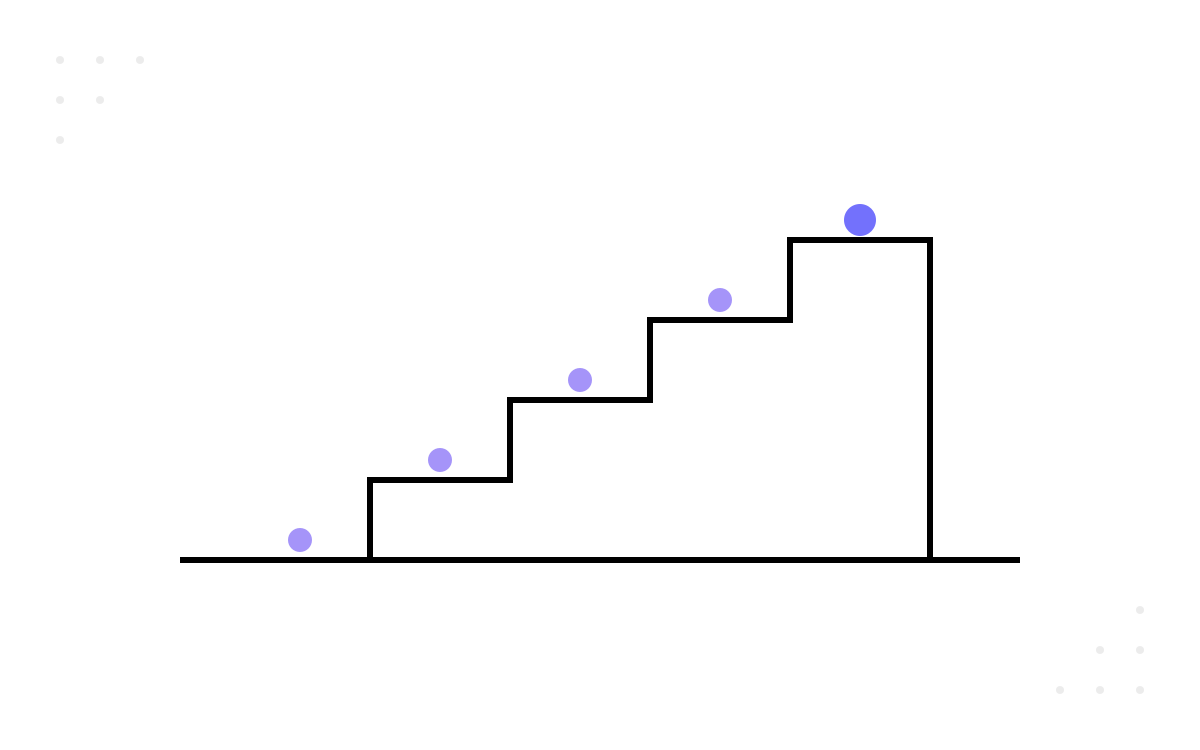
Parts 2 through 5 took the seven disciplines apart and defended their weights. But a discipline list, however carefully priced, is only half a competency model. The other half is the question every review conversation eventually reaches: how good, exactly? Ask an engineer to rate themselves “out of five” against a bare scale and you get a Rorschach test — the confident hear “five means flawless” and give themselves four, the anxious hear “five means world expert” and give themselves two, and the two numbers cannot be compared even though they describe similar people. Both of my frameworks answer this with the same two devices: a five-level ladder with named, defined rungs, and an observable-evidence column that makes every rung checkable. This part is about the ladder, the evidence, and one embarrassing label in my own tables.
One ladder for both frameworks
The software framework and the AI framework use an identical five-level scale, and the sameness is a design decision, not laziness. The frameworks are mirrors — same two-level weighting, same 500-point ceiling — and a shared ladder is what lets one person hold two comparable scorecards. The five levels:
| Level | Name | What it means |
|---|---|---|
| 1 | Novice | Understands the discipline conceptually — its components and vocabulary. Cannot apply it independently; needs close guidance. |
| 2 | Apprentice | Applies basic techniques with guidance. Handles routine situations by following established patterns and templates. |
| 3 | Practitioner | Applies the discipline independently across standard and complex situations. Creates reusable patterns; supports others; handles ambiguity within known domains. |
| 4 | Strategist | Leads and designs at team or project level. Resolves novel problems, sets team-level standards, anticipates failure modes before they occur. |
| 5 | Architect | Sets strategic direction at organisational scale. Defines the discipline's standards, resolves the most ambiguous challenges, advances the practice itself. |
Most competency schemes I have been assessed against did one of two things instead: four proficiency grades of the Awareness–Working–Practitioner–Expert kind, or a scale bolted directly onto career titles, Junior through Principal. I wanted neither. Four grades compress the most interesting territory — the long middle years between “can do it with help” and “sets the standard” — into a single step, and title-bound scales smuggle in the assumption this whole series argues against, that seniority is one number.
One small pleasure of the mirroring: the two progression documents illustrate the same ladder with deliberately different analogies. The software document climbs through cooking — from following a recipe step by step, to improvising substitutions, to running a restaurant group and defining a culinary philosophy. The AI document climbs through chess — from knowing the rules, to club play, to writing theory that shapes how others learn the game. Same shape, different subject, which is quietly the point: the ladder is a structure you can lay over any discipline, not a property of any one of them.
Cumulative, and blind to your job title
Two properties of the ladder do most of its work. The first is that the levels are cumulative — each builds on the capabilities of the level below. There is no route to Strategist that skips the Practitioner behaviours; a person who sets team standards for a discipline they cannot practise independently is not a Strategist, they are a hazard with a style guide.
The second is that the levels are independent of job title. A Senior Engineer might be Level 4 in Engineering Craft and Level 2 in Leadership. A Tech Lead might be Level 4 in Leadership and Level 2 in Business Acumen. The framework measures depth within each discipline, never a single aggregate rank, so a profile is a shape — spiky, lopsided, honest — rather than a rung on the corporate ladder restated.
In the AI framework the decoupling bites harder, because the disciplines are new enough that experience does not transfer automatically. An engineer with fifteen years behind them may genuinely be a Novice at specification engineering — not as an insult, but as a description: they understand the idea and cannot yet apply it unaided. A Staff Engineer can be Level 4 in Prompt Craft and Level 2 in Specification Engineering, and the whole value of the model is that it says so instead of rounding both to “senior”.
Evidence you can point at
Named levels alone do not stop the Rorschach problem — “Practitioner” flatters as easily as “four out of five”. The device that stops it is the second column. In both progression documents, every discipline at every level carries two descriptions: what it looks like, and observable evidence — the artefacts an assessor could check without interviewing anyone.
The difference between the columns is the difference between a trait and a receipt. Delivery at Level 3 looks like breaking complex features into independently valuable increments; its evidence is that features actually ship in thin vertical slices, each delivering user value — something a reviewer can verify from the release history. Leadership at Level 3 looks like consistent mentoring; the evidence is mentees who show measurable growth. Specification Engineering at Level 3 looks like writing comprehensive specifications for multi-component projects; the evidence is that specifications are complete enough for agents to produce correct output on first execution — a claim with a pass rate attached. Prompt Craft at Level 3 is not “good at prompting”; it is a personal library of effective prompts and templates that other people have adopted.
A level claim is a claim about artefacts, and where there is no artefact there is no level. That is the anti-vibes device, and both frameworks state its enforcement rule in the same words: ratings without evidence should be challenged. The assessment method sections spell out where the artefacts come from — code and systems built, specifications written and executed against, context architectures designed, eval harnesses built, feedback that led to visible improvement, decisions made and their outcomes, people developed. Every one of those is a noun you can open, read, or measure. None of them is an adjective.
The evidence column also does a second, subtler job: it makes the levels teachable. An Apprentice who wants to become a Practitioner in Evaluation & Quality does not need to become vaguely better; they need to move from maintaining a handful of manual eval cases to a harness that runs automatically on model updates. The gap between two rungs is a to-do list, not a mystery.
Where careers meet the ladder
Both documents close their discipline tables with a cross-discipline summary mapping career stages — Junior, Mid, Senior, Staff, Principal — to expected level ranges, with the medians running 1 through 5 across the five stages. The mapping is explicitly a guideline: these are medians, not requirements, and individual profiles will vary significantly. A Senior engineer at Level 4 in their strongest discipline and Level 2 in their weakest is not an anomaly; that is what profiles look like.
One row breaks the pattern in each table, and instructively. In the software table, Engineering Craft shows Junior at 1–2 while every other discipline shows 1; in the AI table, Prompt Craft does the same. In both cases it is the discipline a junior arrives already practising — you do not get hired without writing some code, and by now you do not enter the industry without having prompted a model. The rest start cold, whatever the CV says.
The practical use of the summary is targeting. Combined with the weights from the earlier parts, it turns “develop yourself” into an ordering: focus on the highest-weighted discipline where your level sits below the expected range for your stage. A Senior engineer at Level 1 in Delivery (weight 18) should close that gap before chasing Level 5 in Self Organisation (weight 10); a Senior at Level 1 in Specification Engineering (weight 22) has a bigger problem than any polish they could add to Prompt Craft (weight 8). Part 11 builds the full planning loop on exactly this arithmetic.
The Level 0 that does not exist
Now the scar. Both cross-discipline summary tables, as I first wrote them, label their first column "Junior (L0-L1)". There is no Level 0. The scale is defined, twice, in the same documents, as running from 1 to 5, and Novice — Level 1 — is a real level with real content: recognising a discipline's components and vocabulary is an achievement, not an absence. A junior does not enter the ladder at zero; a junior enters at Level 1, and the “L0” in my own tables is a drafting error, not a hidden sixth rung.
I am documenting it rather than quietly fixing it because it demonstrates the exact failure the evidence columns exist to prevent: shorthand inventing scale points. The moment a summary table casually references L0, readers start treating Novice as “basically nothing” and inflating every rating by a rung to escape it — which corrupts precisely the calibration the ladder was built to provide. A framework that demands evidence for every level owes its readers the same precision about how many levels there are.
The ladder, the evidence columns and the career medians together assume one thing this part has taken for granted: that the person holding the pen can see themselves clearly. The research says they cannot — by a measurable margin, in a measurable direction. Next, your self-assessment is lying to you, and what I built into the templates to catch it.